Singers have it easier than most beginners when it comes to shopping, because the instrument is you. You can start voice lessons without buying anything at all. Still, a few simple things make practice at home far more useful, and a few common purchases are not worth the money. Here is what I would actually get.
What you need before the first lesson
Honestly, very little. Bring yourself, a bottle of water, and a song or two you love. Voice lessons here start with breath control and correct placement, and the songs come second. Knowing what you would like to sing still helps, because it tells me where you want to go.
For a child, the same is true. Come as you are. A child who is excited about one particular song has everything they need to start.
A way to hear yourself
The most useful practice tool a singer can own is already in your pocket. Singing feels different from the inside than it sounds from the outside, and nearly every new student is surprised the first time they listen back.
Record a few minutes of each practice session on your phone and listen to it later, away from the moment. You will hear things you cannot hear while singing: a note that goes flat at the end of a phrase, a breath taken in the middle of a word, a sound that is pushed instead of supported. Keep the recordings. Listening to one from your first month after a few months of lessons is one of the best encouragements there is.
Something to give you a starting note
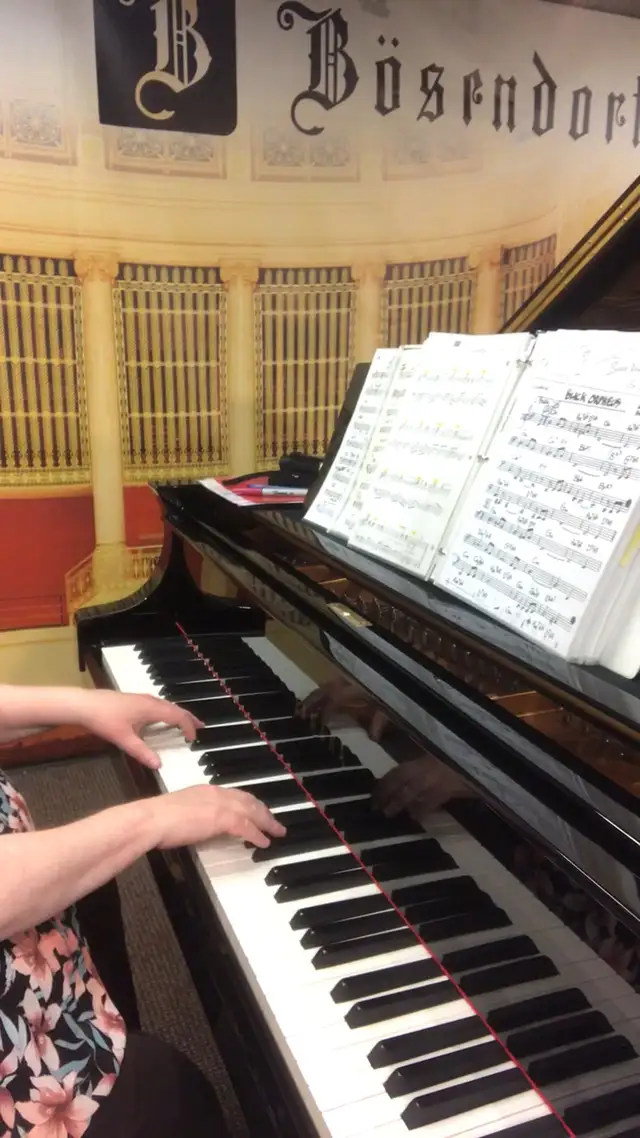
Singers need a way to find their first note and check their pitch. A small keyboard is ideal. It does not need to be fancy, because you will mostly use it to play a starting note, a scale or a simple melody line. Many singers also go on to learn to accompany themselves, and a keyboard at home makes that an easy next step.
If you do not have a keyboard yet, you can use the free reference pitch and ear-training tools on our site. They play clear notes you can match, and they work on any phone or computer.
A music stand, and a mirror
Most people practice singing while looking down at a phone or a book in their lap. That drops the head, closes the throat and squeezes the breath, which undoes the exact things we work on in lessons.
A sturdy music stand at eye level fixes it. Put your lyrics or music on the stand, stand up tall, and sing to the room instead of to the floor. A mirror helps too. Watching yourself shows you tension in the jaw, shoulders that creep up on a high note, or a chest that collapses when you run out of breath.
Do you need a microphone?
Not to start. Learning to sing well happens without one. A microphone becomes useful in two situations.
For performing
If you are singing at church, with a band, at open mics or at school events, it helps to practice with the same kind of microphone you will use on stage. The Shure SM58 is the standard vocal microphone in venues all over the world. It is nearly indestructible, and learning how far to hold it from your mouth is a real skill worth practicing.
For recording and online lessons
If you want better recordings of your practice, or you take lessons online, a USB microphone plugs straight into a computer and sounds much fuller than a laptop’s built-in mic. Add a pair of closed-back headphones so you can hear yourself clearly without feedback. If you already own an SM58, a small audio interface lets you plug it into your computer instead.
If your lessons are online
Online voice lessons work well with a little preparation. A few things make a real difference:
- Use a laptop or tablet rather than a phone if you can, set up so I can see you from the waist up. Breathing and posture are hard to coach when all I can see is a forehead.
- Choose a quiet room with soft furnishings. Bare rooms echo, and echo makes it harder to hear your real sound.
- Put a light in front of you, not behind you, so your face and shoulders are visible.
- Have your water, your music and your keyboard within reach before we start.
Online lessons and our group classes need a reliable internet connection and an appropriate device, so it is worth testing your setup before the first session.
Looking after your voice
Your voice is part of your body, and it responds to how you treat it. Drink water through the day, not just during practice. Get enough sleep. Warm up gently before you sing, and stop if anything hurts or feels scratchy. Pain is not part of singing well, and pushing through it does harm.
For children, this matters even more. Young voices are still developing, so there is no need to push range or volume. Good habits now, like breathing low and singing without strain, will serve them for life.
If hoarseness lasts more than a couple of weeks, see a doctor. That is not something a voice teacher should try to diagnose.
What to skip
You do not need throat sprays, special teas sold as “vocal miracles”, breathing gadgets, or pitch-correction apps. Water, rest, a recording on your phone and regular practice will do more than any of them. Save your money for lessons and for music you love singing.
The short version
Bring water and a song you love. Record yourself on your phone. Get a way to find your starting notes, a music stand at eye level and a mirror. Leave the microphone until you need it for performing or recording, and when you do, buy a good one.