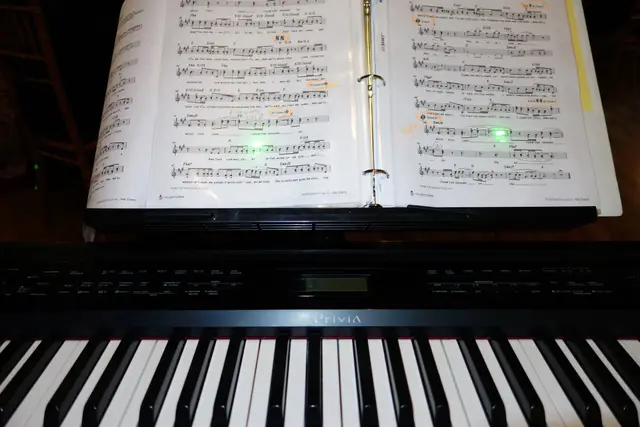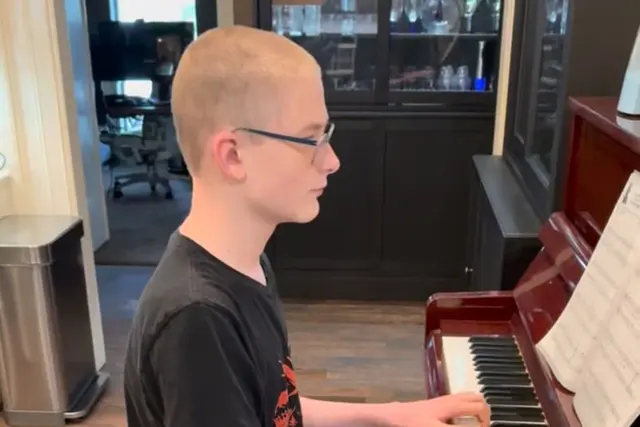
Every parent and every adult beginner asks it sooner or later: how much should I be practicing? The honest answer is less than most people fear, and more often than most people manage. A short, regular habit beats long, occasional sessions every time. Here is how to build one that lasts.
Why little and often works
Learning an instrument is mostly teaching your hands and ears new habits, and habits are built by repetition spread over time. Ten focused minutes a day, five or six days a week, does far more than an hour crammed in the night before a lesson. Your brain keeps working on what you practiced while you sleep, so every day you practice gives it something new to settle.
A weekly lesson with us is thirty minutes. That half hour is where you learn what to work on and how. The days in between are where the progress actually happens. As our studio policies put it, progress depends on attendance, participation, and practice outside the lesson.
A starting point by age
These are not rules, and every student is different. They are a sensible place to begin, and you can build up from there as playing gets more fun.
- Ages 6 to 8
- 10 to 15 minutes a day. Young children concentrate best in short bursts, and stopping while it is still fun keeps them coming back.
- Ages 9 to 12
- 15 to 20 minutes a day. Enough time to warm up, work on one hard spot, and play something they enjoy.
- Teens and adults
- 20 to 30 minutes a day. Split it into two shorter sessions if that fits your day better. Two tens are better than one twenty you keep skipping.
Aim for five or six days a week rather than seven. A day off is fine, and it takes the pressure off a busy week.
What to do with the time
Minutes alone do not make progress. Twenty minutes of playing a piece from the top again and again, stumbling at the same place each time, mostly practices the stumble. Here is a simple shape for a fifteen-minute session. Stretch it to fit longer ones.
- Warm up, 2 minutes. A scale, a few chords or some gentle vocal exercises. Wake the hands or the voice up before asking them for anything difficult.
- The hard spot, 5 minutes. Find the two or three bars that keep going wrong and work only on those. Play them slowly, slowly enough to get them right. Then a little faster.
- The piece, 5 minutes. Now play the whole piece or song, and notice whether the hard spot feels better than yesterday.
- Something fun, 3 minutes. A song you already know, something you are making up, anything you enjoy. Always end on something that feels good.
Slow practice is the secret most beginners resist. If you can play a passage slowly without mistakes, speed comes on its own. If you practice it fast with mistakes, you are teaching your fingers the mistakes. A metronome keeps you honest, and there is a free metronome on our site you can use on any phone. Set it slow, get it right, then nudge it up a few clicks.
For parents: how to help without nagging
A child’s practice habit is really a family habit. These are the things that help most.
- Same time, same place. Practice after a snack, before screens, or right after dinner. When it is part of the routine, it stops being a daily negotiation.
- Keep the instrument out. A guitar on a stand or a keyboard that is always set up gets played far more than one that lives in a case or a closet.
- Sit in for the first few minutes with younger children. You do not need to know anything about music. Your attention is the reward.
- Praise the effort, not the talent. “You worked really hard on that tricky part” builds a child who keeps trying. “You are so talented” builds a child who is scared to make mistakes.
- Ask for a concert. Once a week, let your child play what they have learned for the family. Children love an audience, and it gives practice a purpose.
- Never use practice as a punishment. Music should never be the thing that happens when you are in trouble.
Some days will not happen, and that is normal. One missed day is nothing. Two missed weeks is worth a conversation, not a lecture.
For adult beginners
Adults learn quickly at first, and then life gets in the way. The students who keep going are usually not the ones with the most free time. They are the ones who protect a small, regular slot.
Choose a time you can actually keep, even if it is only ten minutes before work. Leave your instrument where you will see it. On a busy day, play for five minutes rather than skipping, because the habit matters more than the length. And be patient with yourself. Learning at your own pace is fine. The progress is real even when it feels slow, and it shows up all at once a few weeks later.
A few tools that help
You do not need much. A music stand at the right height, so you are not hunched over a book. A tuner, if you play guitar or ukulele, because practicing on an out-of-tune instrument trains your ear the wrong way. A metronome, and something to record yourself with. Your phone does the recording perfectly well.
Our site also has free practice tools: the metronome, a reference pitch to tune and sing against, and an ear-training game. Students use them between lessons, and they need no sign-up or app.
When practice gets hard
Every student hits a stretch where practice feels like a chore or progress seems to stall. It happens to everyone, and it usually passes. Tell your teacher when it does. That is not a confession, it is useful information. Assignments here are matched to each student’s skill level, interests and available practice time, so if the time you have has changed, or the music has stopped being fun, the plan can change with it.
Sometimes the fix is a new piece the student is excited about. Sometimes it is a shorter daily goal. Sometimes it is simply a reminder of how far they have come.
The short version
Practice a little, most days. Start with ten to fifteen minutes for young children and twenty to thirty for teens and adults. Warm up, fix one hard spot slowly, play the piece, and end with something fun. Keep the instrument out, keep the routine steady, and talk to your teacher when it gets hard.